
How to Check Criminal History in Bureau County
Choose the custodian by the question. The Bureau County Judici search is the main remote path to Circuit Court cases. It can show parties, case numbers, charges, events, dispositions, sentences, costs, and payments when those fields are public. It is not a complete statewide rap sheet, and Bureau County coverage starts in late 1988. The Circuit Clerk in Room 100 supplies official court copies.
Gather the full legal name, possible earlier names, approximate birth year, and any incident or case number. Compare the filing year, court, charge, and final disposition before accepting a match. For current custody, contact the Bureau County Jail. For Illinois conviction information, use Illinois State Police rather than treating one county docket as a statewide history.
- Pick Judici for a court case, the arresting agency for a report, or ISP for state conviction information.
- Search the most exact name available, then use a case number when known.
- Compare dates, case type, and court location to avoid a false match.
- Read every count and its outcome. One case can contain both dismissed and convicted counts.
- Order a copy or certification from the custodian when an authoritative record is needed.
Three Bureau County Arrest Records
One event can create three separate files. The arresting police agency writes an incident or arrest narrative. The jail opens a booking and custody record if the person reaches 800 Ace Road. If prosecutors file charges, the Circuit Clerk creates a CF, CM, DT, OV, or TR court file. Each office may assign a different number, and entries can appear at different times.
| Record | Custodian | What it answers |
|---|---|---|
| Incident report | Arresting agency | What officers reported and investigated |
| Booking file | Bureau County Jail | Admission, bond, custody, and release |
| Court case | Circuit Clerk | Charges, docket events, outcome, and sentence |
A booking proves custody was recorded, not guilt. Only the final court disposition explains whether each charge was dismissed, amended, or resulted in a judgment.
Official Illinois Background Checks
The Illinois State Police Bureau of Identification is the central repository. Its Criminal History Information Response Process, or CHIRP, supplies conviction-information inquiries under the Uniform Conviction Information Act. CHIRP requires an authorized account, Illinois Digital ID, and user agreement. It is not an anonymous public rap-sheet search.
A fingerprint inquiry gives a stronger identity match than a name inquiry. People reviewing their own Illinois history may use Access and Review, which has no ISP processing charge, though a live-scan vendor may charge for capture. Court records remain necessary when the exact wording and result of one Bureau County case matter.
The official CHIRP gateway shows where account-based inquiries begin.
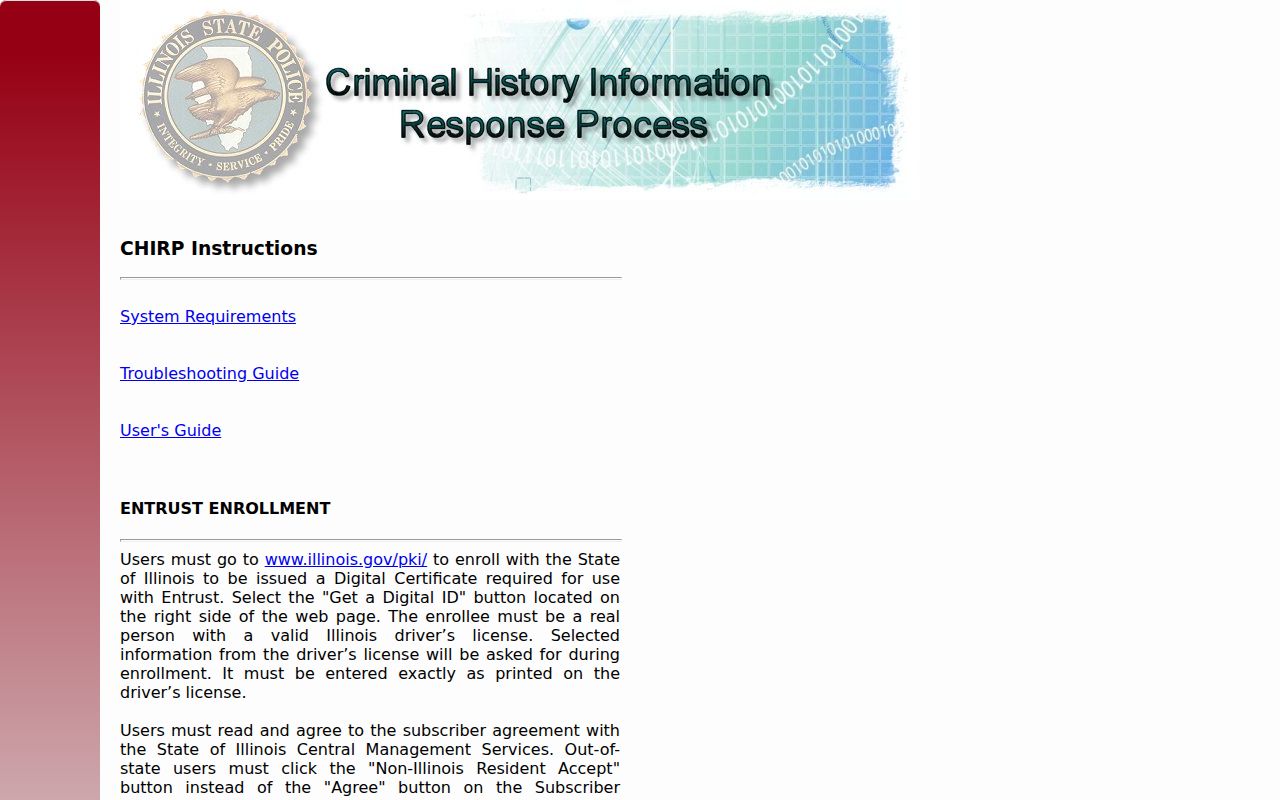
The gateway reflects a key boundary: an ISP response and a Bureau County docket are different products.
CHIRP Is Not a Rap Sheet
CHIRP reports Illinois conviction information within UCIA rules. It does not expose a person's complete state and FBI identity-history record to an anonymous visitor. A delayed disposition or unmatched fingerprint cycle may also leave repository information incomplete. The originating court therefore remains a vital verification source.
The Digital ID login makes that controlled access visible.
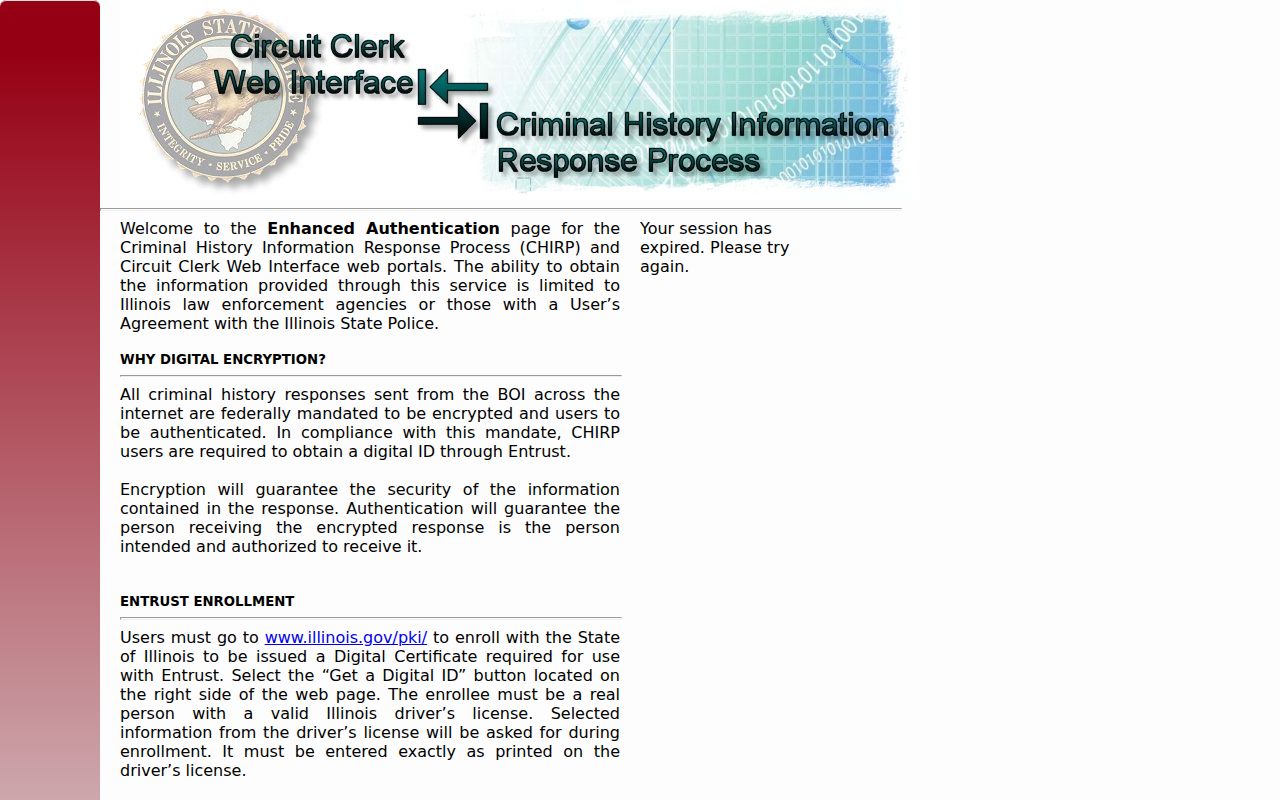
Use Access and Review to inspect or challenge your own Illinois record. Use Room 100 for the authoritative county case file.
Types of Criminal Records
Bureau County agencies create records at each stage. Police write incident reports. The jail records booking, property, housing, bond, visits, and release. Prosecutors decide what to file, and the Circuit Clerk preserves the complaint, docket, orders, judgment, costs, and sentence. ISP connects qualifying fingerprint arrest cycles to reported outcomes. IDOC takes over the custody trail for longer state sentences, while I-SORT records a separate registration duty after a qualifying judgment.
Warrant data also has several sources. The sheriff holds execution material and may confirm current county information by phone. A bench warrant appears in the issuing court file. No official Bureau County public warrant or booking portal was found, so direct confirmation is important.
- Arrest and booking records: held by the arresting agency and county jail.
- Criminal court case files: maintained by the Bureau County Circuit Clerk.
- Conviction information: supplied by ISP through UCIA channels.
- Warrants: verified through the sheriff and issuing court record.
- Custody and registry entries: searched through IDOC or I-SORT when applicable.
Bureau County's New Jail Address
The current Bureau County Jail opened in 2023 at 800 Ace Road in Princeton. It has 115 beds. Older planning documents point to the former 22 Park Avenue West jail, so stale results can send a visitor to the wrong place. Administration uses (815) 875-3344 and is open weekdays from 8:00 a.m. to 4:00 p.m.
The official sheriff page places sheriff and jail functions at Ace Road.
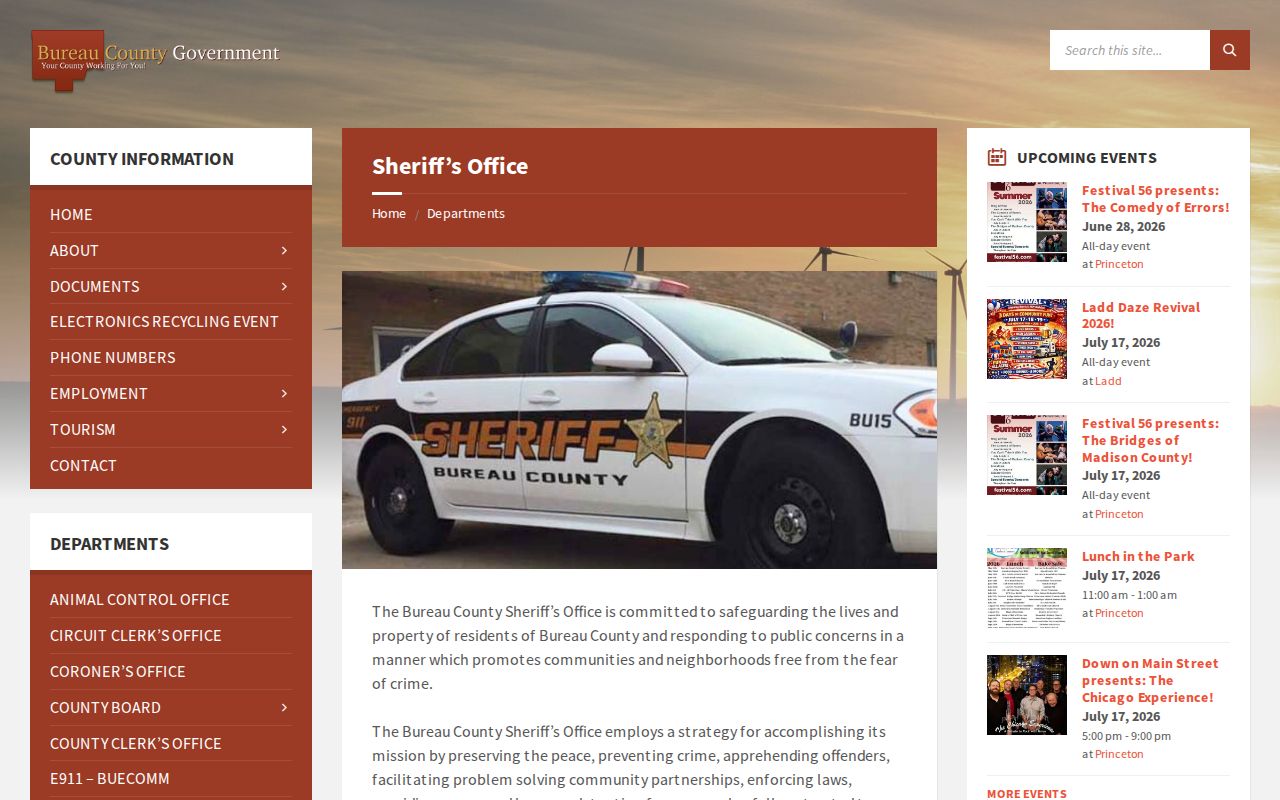
Booking files stay there. Court records remain downtown, so a complete check may require both campuses.
What a Bureau County Criminal Record Shows
The fields depend on the product. A case file identifies the court, parties, charge statutes, events, disposition, judgment, and sentence. A booking record adds physical descriptors, fingerprints, intake data, bond, housing, and release. A state response ties reportable conviction data to the repository identity process. Read count by count because one prosecution may contain allegations with different outcomes.
| Name & Identifiers | Legal name, aliases, birth details, and agency or case numbers. |
|---|---|
| Arrest / Booking Data | Arrest date, agency, intake, bond, custody, and release entries. |
| Charges & Statutes | Each alleged offense, Illinois citation, class, and amendments. |
| Disposition | The result for each count, such as dismissal, acquittal, or conviction. |
| Sentence | Custody, probation, fines, costs, and court-ordered conditions. |
| Custody / Supervision Status | County jail, IDOC, probation, parole, or release status where public. |
Bureau County Records in Room 100
The Circuit Clerk's Criminal Division is on the main floor of the Bureau County Courthouse, 700 South Main Street, Princeton. Room 100 holds a public workstation and the authoritative case file. The office opens weekdays from 8:00 a.m. to 4:00 p.m. Call (815) 872-2001, extension 559 for criminal matters. Copies are available, but the research did not identify a fixed criminal-copy or certification price.
The county government gateway connects readers with the local record offices.
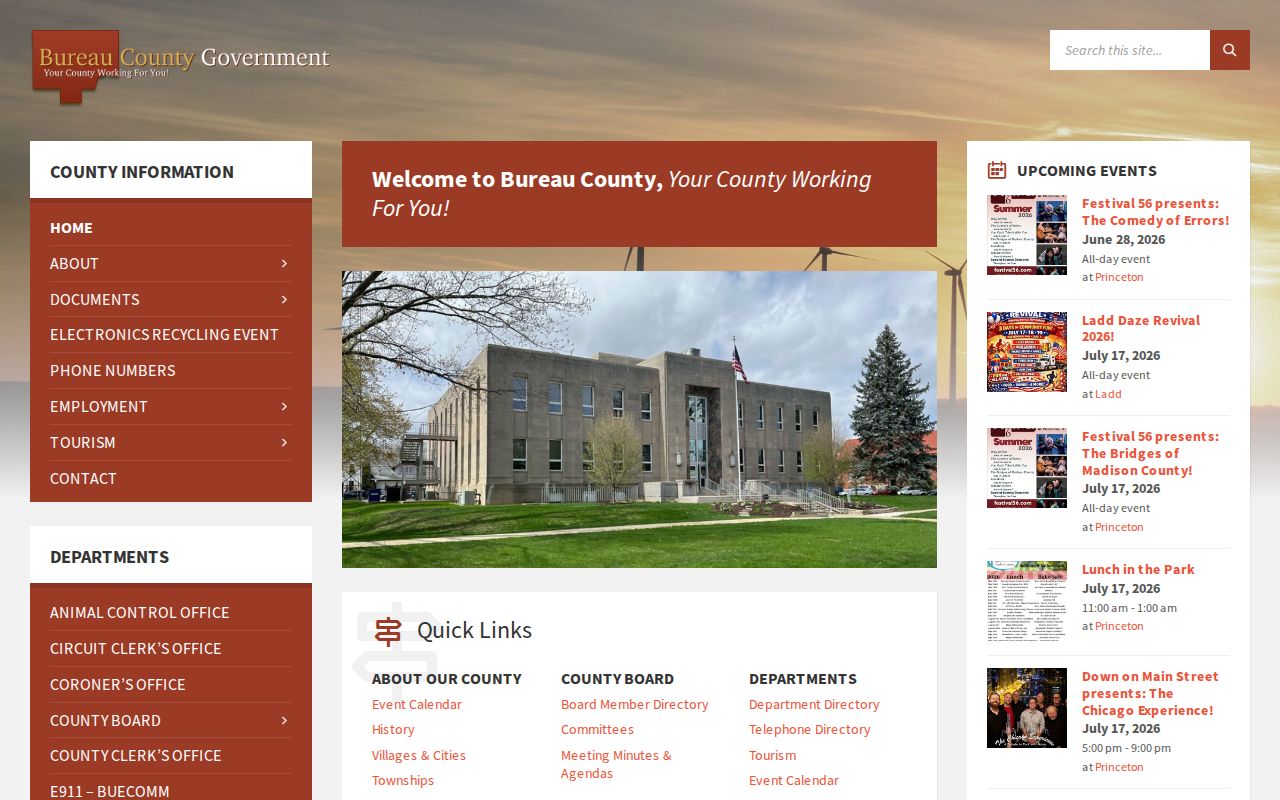
Use the workstation when Judici blocks access, lacks detail, or cannot show an older matter. Sealed and suppressed records remain restricted.
Public Access Laws
Illinois separates agency records, court files, and repository information. The Illinois Freedom of Information Act governs many local-agency requests, but judicial records follow court access rules. UCIA controls dissemination of state conviction information. The Criminal Identification Act governs repository records and much of the expungement and sealing process. Registry access follows separate registration and community-notification laws.
Key Statutes:
5 ILCS 140 sets the Illinois FOIA request and exemption framework.
20 ILCS 2635 governs public conviction-information inquiries under UCIA.
20 ILCS 2630 covers criminal identification records and access relief.
Illinois Remote Access Policy limits what court data may appear online.
Bureau County Record Check Fees
ISP publishes distinct prices for electronic and paper UCIA inquiries. A live-scan vendor may add a collection charge. The county clerk also charges for copies, filings, and some card transactions, but no researched fixed criminal-copy price should be assumed. Confirm the total before paying.
| ISP service | Electronic | Paper |
|---|---|---|
| Name UCIA inquiry | $10 | $16 |
| Fingerprint UCIA inquiry | $15 | $20 |
| State and FBI processing | $27 | Not listed |
| Access and Review | No ISP fee | Vendor fee may apply |
The ISP fee schedule is the source to check for changes.
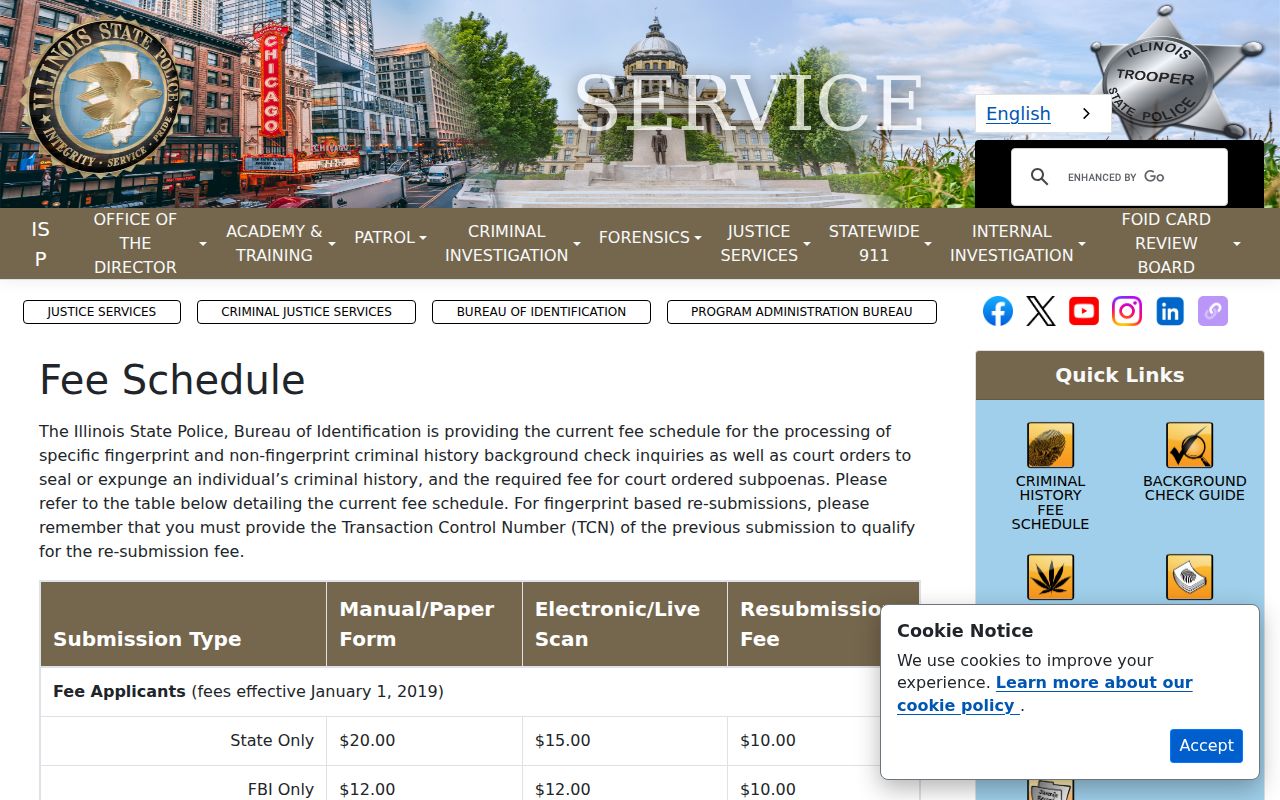
A state inquiry, personal Access and Review file, and certified Bureau County judgment answer different questions. Choose by scope, not price alone.
Sealed, Expunged & Restricted
Expungement generally destroys or returns eligible records, subject to exceptions. Sealing blocks ordinary public access but preserves authorized access. Juvenile files, victim identifiers, and matters under court order can also be restricted. A missing online result is not proof that no record ever existed.
Bureau County uses statewide forms with local rules. The Circuit Clerk instructions require the original plus four copies, a $60-per-case clerk fee by money order, applicable ISP payment, and a 60-day objection period. Automatic relief is phased. Future statutory milestones do not mean every record is already sealed in 2026.
The county's filing page shows the required local route.
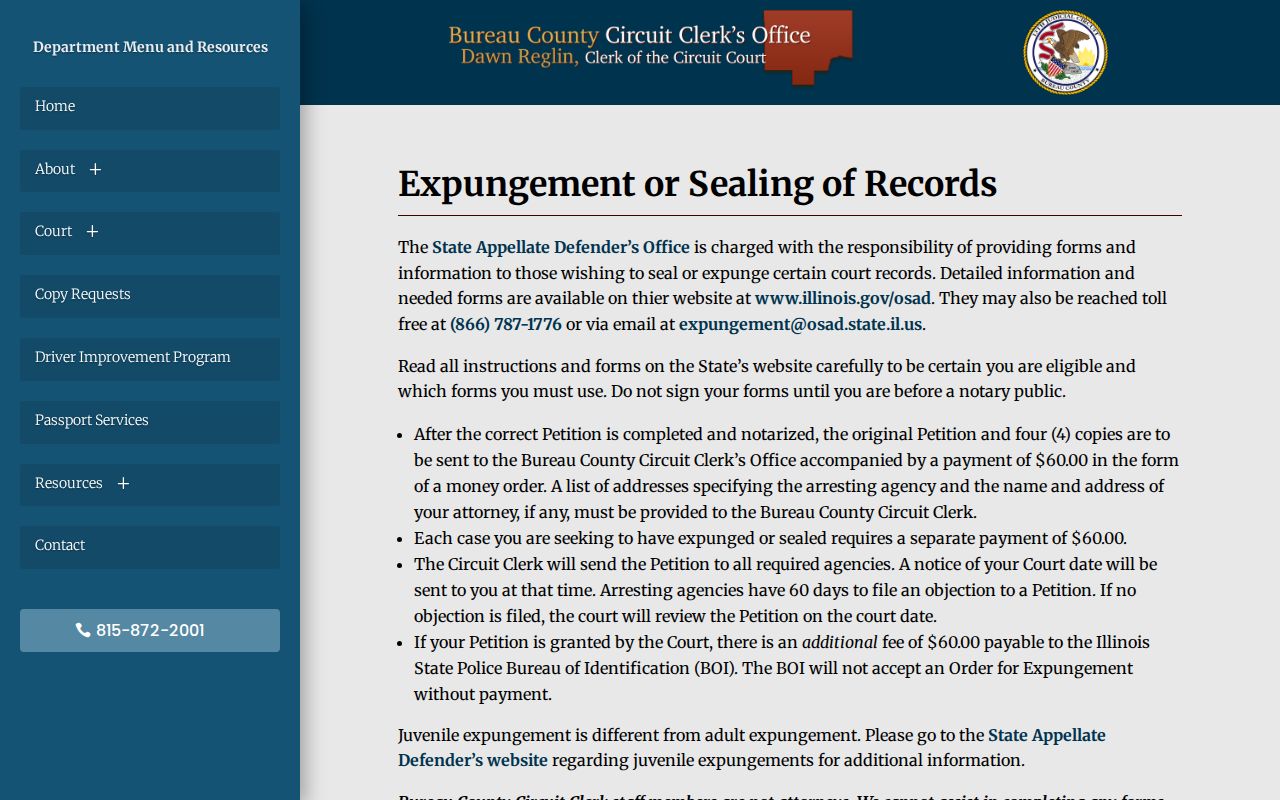
After relief, verify updates with the court, arresting agency, and ISP because their records follow different paths.
Bureau County Probation Records
The 13th Judicial Circuit Probation and Court Services Department serves Bureau, Grundy, and LaSalle counties. Bureau staff work on the courthouse third floor at 700 South Main Street and use (815) 872-8951. No public probationer name search is advertised. Verify a sentence or petition to revoke through the clerk, then ask probation only for information it may lawfully release.
The probation directory identifies the office and its role.
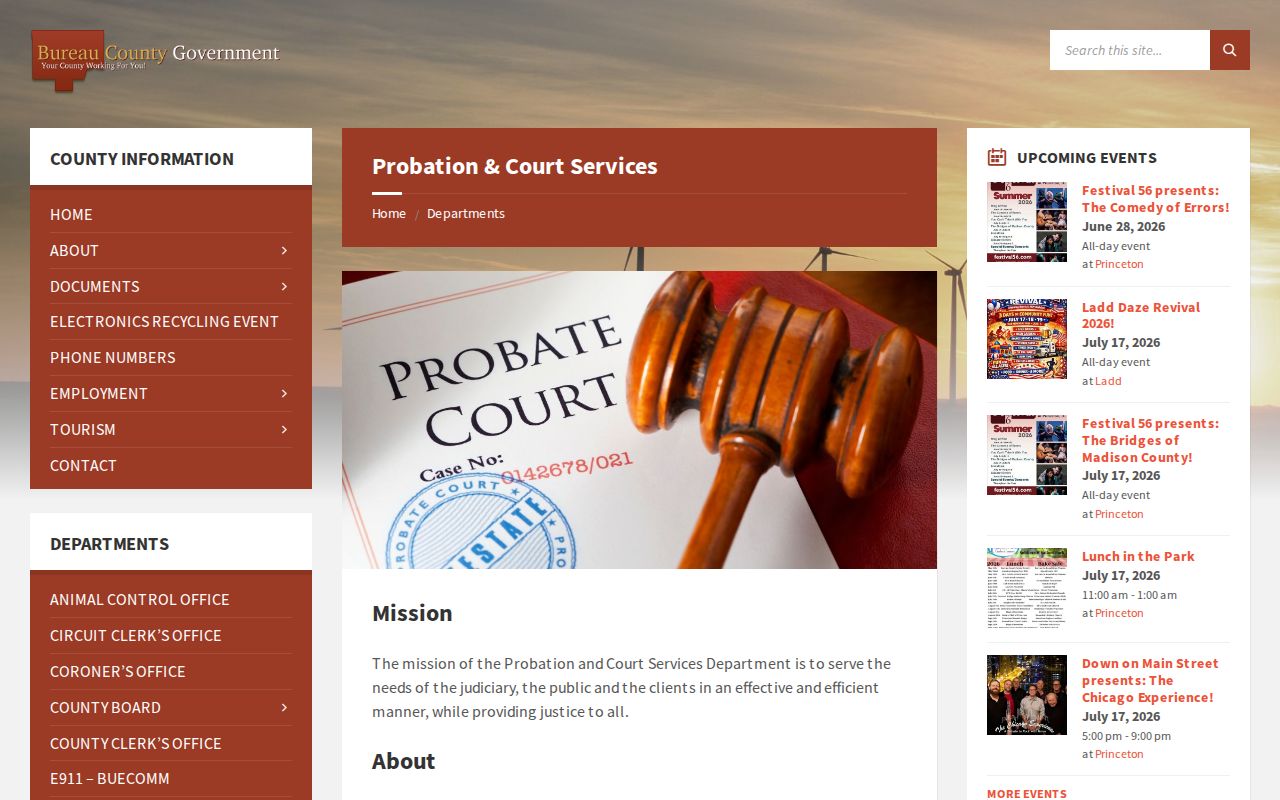
Probation is a court sentence in the community. Parole or mandatory supervised release follows state custody and involves IDOC and the Illinois Prisoner Review Board.
No Bureau County Booking Roster
No official public county booking roster or warrant portal was located. For recent custody, call the jail at (815) 875-3344. Ask the arresting agency for its report, then check Judici for a filed case. When a longer sentence moves the person into state custody, use the IDOC Individuals in Custody search. Federal custody belongs in the Bureau of Prisons locator.
This fallback avoids unofficial aggregators and explains why someone may disappear from one system while remaining visible in another. A new arrest may also precede the charging decision, so Judici can lag behind the booking.
Criminal Records by City in Bureau County
Princeton, Spring Valley, and DePue police keep reports made by their officers, but none has a separate municipal court search or city jail roster. Bookings route to Ace Road and prosecutions route to Circuit Court. Start with the city for an incident narrative, then follow the record into county systems.
Princeton Criminal History
Population 7,832 · County seat reports connect to Ace Road bookings and Room 100 cases.
Spring Valley Criminal History
Population 5,582 · City police publish a local FOIA route and use regional dispatch.
DePue Criminal History
Population 1,633 · Village reports flow into county booking and court systems.
Bureau County's Two Records Campuses
The 1937 courthouse and 2023 jail explain the local trail. The downtown courthouse remains home to the clerk, courts, probation, State's Attorney, and Public Defender. Sheriff and jail operations sit at Ace Road. The physical split mirrors the legal split between booking and case records.
Bureau County covers roughly 875 square miles. The sheriff reports 20 patrol deputies and 19 corrections deputies, while city departments handle local calls. Multiagency work can produce records at more than one office. Identify the lead or arresting agency before making a FOIA request.
The county's geography also affects access. Free parking surrounds the courthouse, and the Illinois Courts directory lists a public workstation, e-filing kiosk, internet, law library, language access, and disability coordination. Bureau-Putnam Area Rural Transit requires advance arrangement, while Amtrak serves Princeton. Call before a visit if recording equipment or an unusual device is needed because the researched court material did not state a full security list.
Historical details help identify the right building. The present courthouse entered service in 1937 as a Public Works Administration project built around an older retained vault. Its court-record function never moved with the jail. The Ace Road facility opened much later and houses four eight-bed dorms as part of its 115-bed design. An April 2024 inspection count of nine was only a one-day snapshot, not an annual population figure. These dates and functions are more reliable routing clues than an old address copied by an unofficial directory.